
Table of Contents
ToggleWisdom of the Bhagavad Gita for the Investor Panic in the stock market - 8 Tips for investors
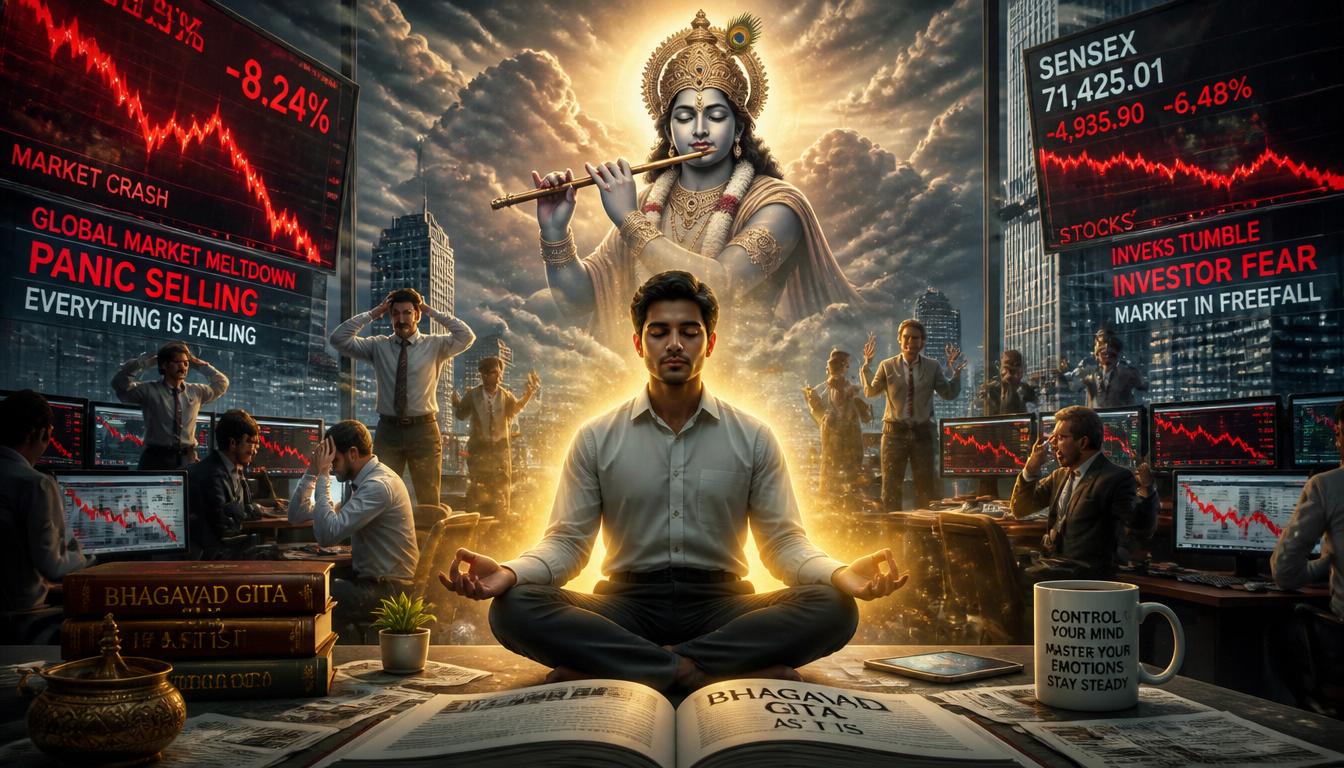
There are moments in life when the world feels unstable and panic. Gita Teaches about the panic in the market
There are moments in life when the world feels unstable and panic. Gita Teaches about the panic in the market
Stock markets crash.
Headlines scream fear.
People rush to panic sell.
Conversations become heavy with anxiety, regret, and uncertainty.
In those moments, most people believe the real battle is happening in the market. But the Bhagavad Gita teaches something deeper:
The greatest battle is not outside. It is inside the human mind.
The market simply exposes what already lives within us — fear, greed, impatience, attachment, ego, and insecurity.
And that is why the teachings of the Bhagavad Gita are timeless.
Because long before modern finance existed, it explained the psychology behind human suffering during uncertainty.
Panic Does Not Begin in the Market, It Begins in the Mind
When prices fall suddenly, logic disappears.
A calm investor becomes emotional. A patient person becomes impulsive.
Someone who once believed in long-term growth suddenly wants to escape immediately.
Why?
Because fear hijacks clarity.
In the Gita, Arjuna experiences a similar collapse before the great battle of Kurukshetra. His hands tremble. His thoughts become confused. His confidence vanishes. He says he cannot think clearly.
Sound familiar?
That is exactly what happens during financial panic.
People stop acting from wisdom. They start reacting from emotion.
And then Krishna gives one of the most powerful lessons on emotional intelligence ever spoken:
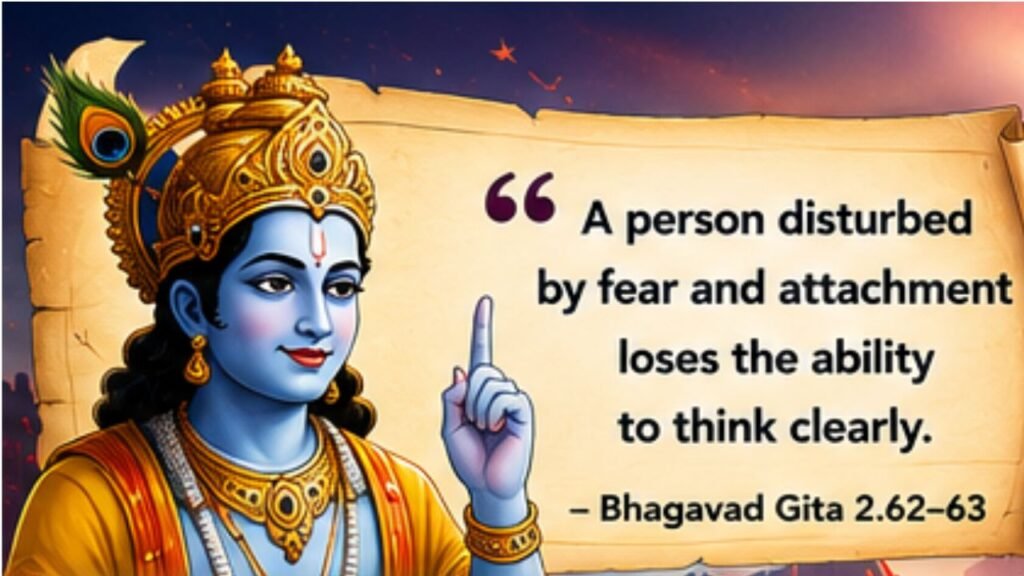
“A person disturbed by fear and attachment loses the ability to think clearly.”
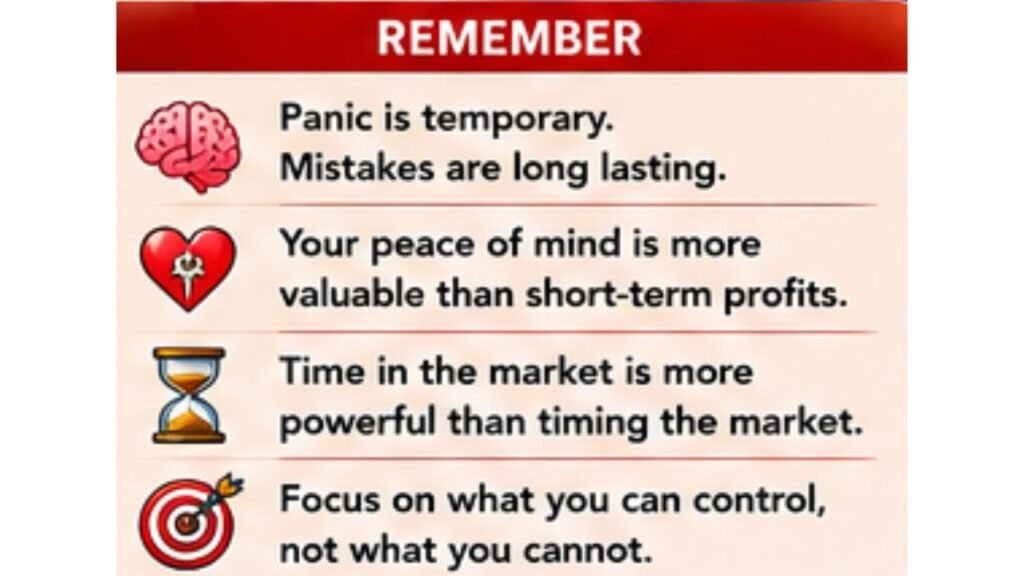
The market may fall for a few months. But emotional decisions made in panic can damage years of wealth, peace, and confidence.
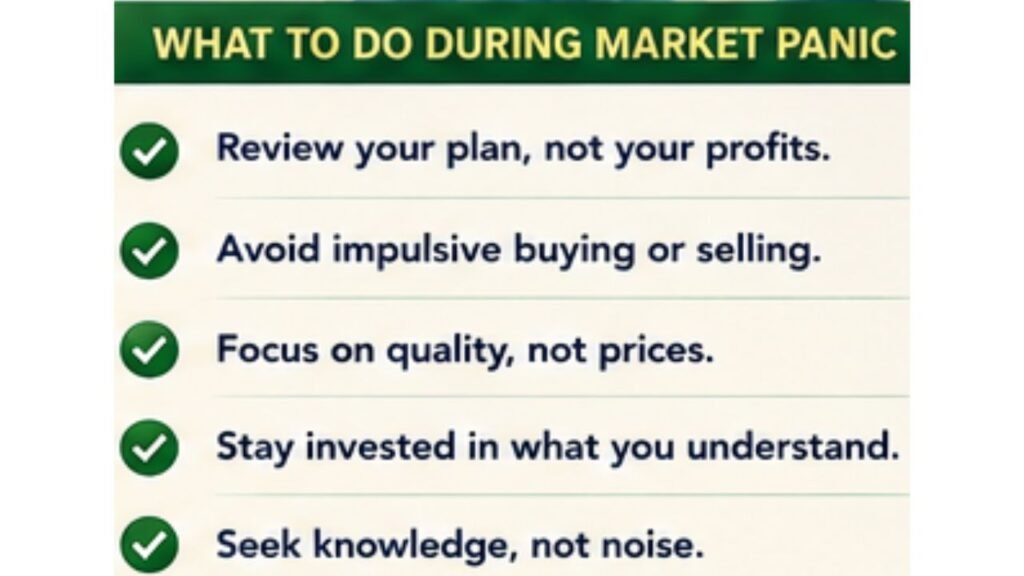
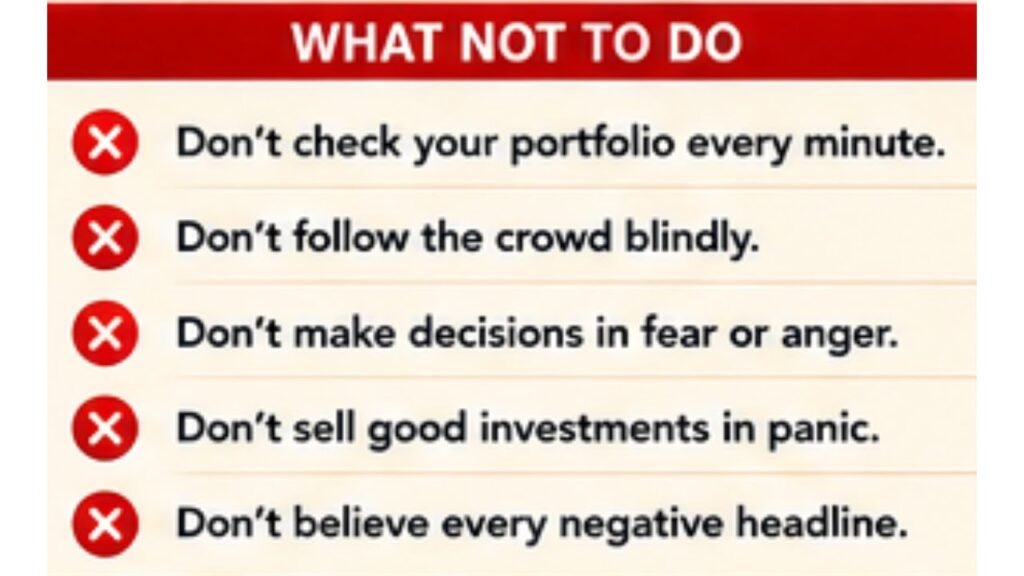
The Real Cost of Panic Is Not Financial, It Is Psychological
Most people think market panic only destroys money.
But the deeper damage is internal.
Panic steals:
- Peace of mind
- Sleep
- Decision-making ability
- Confidence
- Relationships
- Mental balance
A person checking prices every five minutes is not just losing financial stability.
They are losing emotional stability.
The Gita repeatedly teaches that inner balance is greater than outer circumstances.
Because external situations will always change.
Markets rise.
Markets fall.
Economies expand.
Economies collapse.
But a stable mind remains powerful in every season.
Emotional Control Is a Financial Superpower
Modern finance talks about strategy.
The Gita talks about consciousness.
And consciousness decides strategy.
Two people can have the same investment knowledge, same opportunities, and same resources — yet one succeeds while the other self-destructs during volatility.
Why?
Because knowledge without emotional control becomes useless under pressure.
The Gita teaches the principle of Sthitaprajna — a person of stable wisdom.
Such a person:
- Does not become arrogant in success
- Does not collapse in failure
- Does not react impulsively
- Remains centered in uncertainty
Imagine how different investing would become if people practiced this mindset.
Most financial mistakes are not caused by lack of intelligence.
They are caused by:
- Fear during crashes
- Greed during rallies
- Impatience during slow growth
- Comparison with others
- Attachment to quick results
The Gita exposes all of these emotional traps with astonishing accuracy.
Attachment Creates Suffering
One of the deepest teachings of the Gita is this:
“Attachment to outcomes creates suffering.”
This does not mean you should avoid ambition or stop building wealth.
It means your peace should not depend entirely on results you cannot fully control.
Markets are unpredictable.
Global events are unpredictable.
Human behavior is unpredictable.
But your response can still remain conscious.
When people become emotionally attached to constant gains, every small decline feels like personal destruction.
That attachment creates panic.
And panic creates poor decisions.
The Gita teaches detached action:
- Do your duty wisely
- Make informed decisions
- Stay disciplined
- But do not emotionally collapse over temporary outcomes
This mindset creates extraordinary resilience.
Clarity Is More Valuable Than Prediction
Everyone wants to predict the future. The Gita teaches something more important:
Develop clarity instead.
Because nobody controls the future.
Not experts.
Not economists.
Not billionaires.
Not financial influencers.
But clarity allows intelligent action even during uncertainty.
A clear mind:
- Avoids herd mentality
- Thinks long term
- Separates noise from truth
- Acts from discipline instead of fear
During market panic, most people follow the crowd.
But crowds are emotional.
Wisdom is rarely loud.
The Gita repeatedly reminds us that the uncontrolled mind becomes its own enemy.
And nowhere is this more visible than financial panic.
Fear Makes People Forget Their Values
One dangerous effect of panic is that it changes character.
Fear can make good people:
- Dishonest
- Aggressive
- Selfish
- Desperate
- Emotionally reactive
The Gita warns against decisions made under emotional disturbance because such decisions disconnect us from higher intelligence.
In difficult times, people reveal who they truly are.
Some spread panic.
Some spread wisdom.
Some lose themselves completely.
Some become calmer than ever before.
The difference is inner mastery.
The Market Rewards Patience More Than Excitement
The modern world glorifies speed.
Quick profits.
Instant success.
Fast results.
But the Gita teaches patience, discipline, and steady action.
Nature itself moves through cycles:
- Day and night
- Seasons
- Growth and decay
Markets also move in cycles.
Yet panic makes people believe every downturn is permanent.
This emotional exaggeration is dangerous.
The Gita teaches us to see reality beyond temporary fluctuations.
A calm person understands:
- Difficult phases pass
- Emotions settle
- Opportunities return
- Stability comes back
Patience is not weakness.
It is emotional strength.
Inner Stability Creates Better External Decisions
The goal is not to become emotionless.
The goal is to become emotionally intelligent.
The Gita never asks humans to suppress feelings.
It teaches mastery over them.
A wise investor still feels concern during volatility.
But they do not surrender control to fear.
They pause.
Reflect.
Think clearly.
Act consciously.
That single difference changes everything.
Because one emotional decision made in panic can undo years of discipline.
What the Gita Ultimately Teaches About Financial Uncertainty
The greatest lesson is this:
Peace should not depend on market conditions.
If your emotional state rises and falls with every chart, headline, or prediction, your mind becomes a prisoner of external events.
The Gita invites us toward a different kind of wealth:
- Clarity over confusion
- Discipline over impulse
- Wisdom over fear
- Stability over chaos
And ironically, those qualities often lead to better financial outcomes too.
Because calm minds make stronger decisions than fearful minds.
Final Reflection
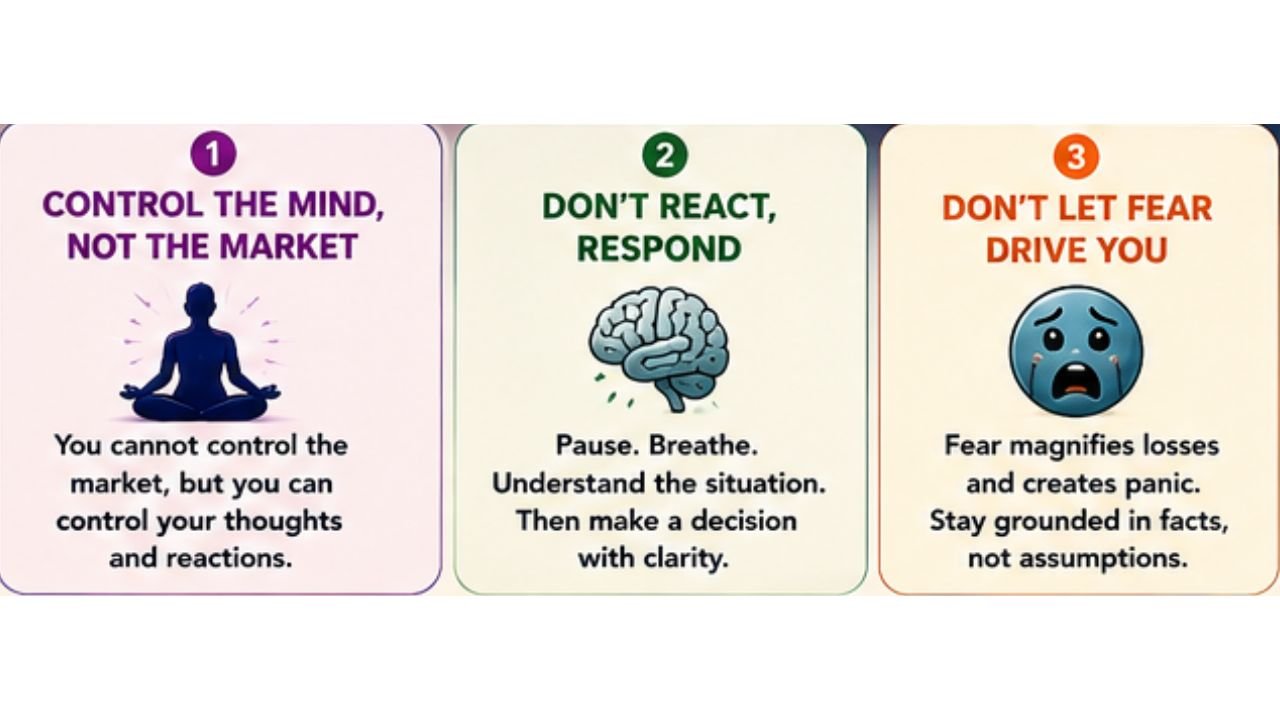


The next time markets panic, observe carefully.
You will see two battles happening simultaneously:
One in the financial world.
Another inside human consciousness.
The second battle is far more important.
Because fortunes can be rebuilt.
But a mind consumed by fear slowly loses its freedom.
The teachings of the Bhagavad Gita remind us that true strength is not measured by how we act when everything is easy.
It is measured by how calm, clear, and conscious we remain when uncertainty surrounds us.
And perhaps that is the real wealth the Gita wants humanity to discover.