

Table of Contents
ToggleUnderstanding How Fear and Greed Emotions Influence Financial Decisions—and How Wisdom Helps Us Stay Balanced
The Market Is Not Always Your Biggest Enemy. Sometimes, It Is Your Own Mind.
Imagine this.
The market has been rising for months.
Everywhere you look, people are talking about profits. A friend tells you how much money they made. Social media is filled with screenshots of gains. Financial news channels are celebrating new highs.
You feel something inside you.
“I should invest more. What if I miss this opportunity?”
So you invest.
Then the market suddenly falls.
5%.
Then 10%.
Then 20%.
The same people who were celebrating yesterday are now predicting disaster.
Your phone keeps showing red numbers.
You begin checking your portfolio every few minutes.
Your heart starts racing.
You think:
“Should I sell?”
You know you invested for the long term.
But fear whispers:
“Get out before you lose everything.”
You sell.
A few months later, the market recovers.
And you watch helplessly as prices rise again.
This is one of the most painful experiences in investing.
But here is the uncomfortable truth:
The market did not necessarily destroy your investment strategy. Your emotions may have destroyed your discipline.
This is where the wisdom of the Bhagavad Gita becomes remarkably relevant.
The Gita was not written to teach stock-market investing.
But it teaches something even more fundamental:
How to manage the human mind when circumstances become uncertain.
And that is exactly what every investor needs.
Your 7 Days fear and Greed challange
Invest wisely Live Peacefully
Questions Every Investor Should Ask

22 Ways to manage the human Emotions of Fear and Greed mind when circumstances become uncertain.
1. Fear and Greed in stock markets: The Two Invisible Forces Behind Financial Decisions
Most financial decisions appear logical from the outside.
But underneath them are often two powerful emotions:
Fear
Fear says:
- “What if I lose money?”
- “What if the market crashes?”
- “What if I make the wrong decision?”
- “What if everyone else is selling?”
- “What if my future becomes insecure?”
Greed
Greed says:
- “I want more.”
- “This stock is going up; I must buy now.”
- “Everyone is making money.”
- “Why should I settle for 10% when I could make 50%?”
- “This time will be different.”
- “I cannot afford to miss this opportunity.”
Fear pushes us away from opportunity.
Greed pulls us toward excessive risk.
And between the two stands the investor.
The challenge is not to eliminate emotions.
The challenge is to prevent emotions from becoming the decision-maker.
2. Why Do Intelligent People Make Irrational Financial Decisions?
This is one of the most interesting questions in investing.
A person may be highly educated.
They may understand financial statements.
They may know valuation.
They may understand economics.
They may have years of investment experience.
Yet during a market crisis, they can still panic.
Why?
Because financial intelligence and emotional intelligence are not the same thing.
Knowing what to do is one skill.
Having the emotional strength to actually do it during stressful circumstances is another.
A person may know:
“I should not sell in panic.”
But when their portfolio is falling rapidly, knowledge may become weaker than emotion.
This is why successful investing requires two forms of intelligence:
Financial intelligence tells you what is happening.
Emotional intelligence determines how you respond to it.
3. The Bhagavad Gita Begins With a Person in Emotional Crisis
One of the most powerful aspects of the Gita is that its wisdom begins with a human being who is confused.
Arjuna is not presented as an ignorant person.
He is a skilled warrior.
Yet when confronted with an emotionally overwhelming situation, his clarity disappears.
His body reacts.
His mind becomes confused.
His confidence weakens.
He does not know what he should do.
This is remarkably similar to what happens during financial uncertainty.
When markets are calm, almost everyone feels like a disciplined investor.
The real test comes when:
- prices collapse,
- uncertainty increases,
- predictions conflict,
- friends panic,
- news becomes frightening,
- and your own money is at risk.
That is when the real investor appears.
Not when the market is rising.
When the market is falling.
4. The First Lesson: Do Not Let Fear Make Your Decisions
Fear is useful.
It warns us about danger.
Without fear, people would take reckless risks.
The problem begins when fear becomes excessive.
A falling market can create a mental illusion:
“If prices are falling today, they will keep falling forever.”
But markets do not move in straight lines.
Economic conditions change.
Businesses adapt.
Interest rates change.
Investor sentiment changes.
Opportunities change.
The future is uncertain.
Therefore, the wise response to uncertainty is not blind optimism.
It is calm evaluation.
Ask:
“Has the fundamental situation changed, or has my emotion changed?”
This single question can prevent many bad decisions.
5. The Second Lesson: Do Not Let Greed Control You
Fear receives most of the criticism in investing.
But greed can be equally dangerous.
Fear makes people sell too quickly.
Greed makes people buy too aggressively.
Consider what happens during a strong bull market.
An investor sees others making money.
They become uncomfortable.
Then they think:
“I am missing out.”
They invest more.
The market rises further.
Their confidence increases.
They invest even more.
Eventually, they stop asking:
“Is this investment suitable for me?”
Instead, they ask:
“How much more can I make?”
That is the moment when investing can quietly become speculation.
The Gita teaches the importance of controlling desire rather than becoming controlled by desire.
This is extremely relevant to wealth creation.
Wanting to grow wealth is healthy.
Becoming emotionally dependent on ever-increasing wealth is dangerous.
6. Attachment Is the Hidden Link Between Fear and Greed
This is where the Gita’s wisdom becomes especially powerful.
Fear and greed may look like opposite emotions.
But underneath them is often the same thing:
attachment.
If I am deeply attached to making money, I become afraid of losing money.
If I am deeply attached to a particular return, I become frustrated when the return does not arrive.
If I am attached to being right, I refuse to admit that my investment thesis may be wrong.
If I am attached to comparing myself with others, someone else’s success makes me feel unsuccessful.
Attachment creates emotional instability.
And emotional instability creates poor decisions.
The Gita does not tell us to stop acting.
It teaches us to act without becoming psychologically imprisoned by the outcome.
7. What Does “Detachment” Really Mean for an Investor?
Detachment is often misunderstood.
It does not mean:
“Do not care about your money.”
It does not mean:
“Invest without thinking.”
It does not mean:
“Accept losses passively.”
Instead, financial detachment means:
Care deeply about the quality of your decision, but do not allow the outcome to completely control your emotional state.
You research.
You evaluate.
You diversify appropriately.
You understand risk.
You create a financial plan.
You review your assumptions.
And then you accept that the future cannot be controlled completely.
That is mature investing.
8. The Difference Between a Reaction and a Response
This distinction can change your financial life.
Reaction
Something happens.
Emotion rises.
You immediately act.
Response
Something happens.
You pause.
You understand the situation.
You examine the facts.
You consider alternatives.
Then you act.
The time between emotion and action is where wisdom lives.
During a market crash, that pause can be extremely valuable.
Instead of immediately selling, ask:
“What exactly am I afraid of?”
Maybe you are afraid of losing money.
Maybe you are afraid of being wrong.
Maybe you are afraid because everyone around you is panicking.
Maybe you are afraid because you invested more than you could emotionally tolerate.
Each problem requires a different solution.
9. The Problem of “I Don't Want to Lose”
Loss aversion is one of the strongest emotional forces in investing.
People often experience the pain of losing money more intensely than the pleasure of gaining a similar amount.
That is why an investor may hold a fundamentally weak investment simply because they cannot accept a loss.
They think:
“I will sell when I recover my money.”
But the market does not know your purchase price.
The market does not care what price you paid.
The correct question is not:
“Can I get back to my buying price?”
The better question is:
“If I had this money today, would I still choose this investment?”
That question removes emotional attachment to the past.
10. The Problem of FOMO
FOMO means: Fear of Missing Out.
It is one of the most powerful emotions in modern investing.
You see a stock rising.
Everyone seems to be making money.
You feel left behind.
You buy—not because your research supports the decision, but because you are afraid of missing the opportunity.
This is emotional investing.
And FOMO becomes particularly dangerous when social media enters the picture.
You see someone’s success.
You do not see their losses.
You see the winning trade.
You do not see the ten failed trades.
You see the luxury lifestyle.
You do not see the financial stress behind it.
Therefore:
Never compare your complete financial life with someone else’s highlight reel.
11. A Gita-Based Solution to FOMO
When you feel the urge to invest because everyone else is doing it, pause.
Ask yourself five questions:
1. Do I understand what I am buying?
If not, stop.
2. Would I buy it if nobody knew about it?
If not, investigate your motivation.
3. Am I investing because of research or excitement?
Be honest.
4. Can I tolerate a significant decline?
If not, reconsider the risk.
5. What is my actual financial goal?
A good investment should serve your financial plan—not your ego.
12. Market Panic: When Everyone Wants the Same Door
Imagine a crowded theatre.
Someone suddenly shouts:
“Fire!”
Everyone runs toward the exit.
Nobody stops to ask:
“Where exactly is the fire?”
The crowd moves because the crowd is moving.
Markets can behave similarly.
One person sells.
Another sees the fall and sells.
A third sees both selling and sells.
Soon thousands of people are reacting to one another.
This creates a feedback loop:
Fear → Selling → Falling Prices → More Fear → More Selling
The wise investor does not automatically assume that the crowd is wrong.
But neither does the wise investor automatically follow the crowd.
They investigate.
They think.
They assess.
They decide.
13. What Should You Do When the Market Falls?
There is no universal answer such as:
“Always hold.”
or
“Always sell.”
Financial decisions depend on individual circumstances, investment objectives, risk tolerance, time horizon, asset quality, liquidity needs, and the reason for owning the investment.
But there is a universal principle:
Do not make a major financial decision simply because you are emotionally overwhelmed.
Instead, follow a process.
Step 1: Stop
Do not react immediately.
Step 2: Breathe
Give your nervous system time to settle.
Step 3: Identify the emotion
Ask:
“Am I afraid, greedy, angry, embarrassed, or simply influenced by others?”
Step 4: Examine the facts
What actually changed?
Step 5: Revisit your original reason
Why did you invest?
Step 6: Reassess the risk
Is your financial situation still suitable for the investment?
Step 7: Take action consciously
If action is required, act because of your analysis—not because of panic.
14. What If You Are Already Panicking?
This is a common problem.
You may already be checking your portfolio repeatedly.
You may be unable to sleep.
You may be imagining the worst possible outcome.
Start by separating facts from stories.
Write down:
Facts
“My portfolio has fallen 15%.”
Story
“I am going to lose everything.”
The first is information.
The second is a prediction created by fear.
This distinction is incredibly powerful.
Ask:
“What do I actually know, and what am I imagining?”
Fear becomes weaker when assumptions are separated from facts.
15. What If You Have Already Made a Mistake?
This may be one of the most important lessons.
You bought because of greed.
You sold because of fear.
You followed someone else’s advice.
You invested without understanding the risk.
Now you regret it.
What should you do?
Do not spend your entire future emotionally fighting your past.
Learn.
Accept.
Review.
Correct.
Move forward.
The Gita teaches action based on wisdom rather than being trapped by the past.
A financial mistake should become a teacher—not a permanent identity.
Instead of saying:
“I am a terrible investor.”
Say:
“I made a poor decision. What can this decision teach me?”
That shift changes regret into learning.
16. What If You Are Afraid of Losing Your Life Savings?
This requires a different approach.
Sometimes fear is not irrational.
If someone has invested money needed for:
- essential expenses,
- emergencies,
- near-term obligations,
- healthcare,
- education,
- or other important financial needs,
then the problem may not simply be emotional.
The portfolio may be unsuitable for the person’s financial situation.
This is why emotional intelligence must be combined with financial planning.
Ask:
“Is my fear telling me that I am emotionally weak—or is it telling me that I have taken more risk than I can realistically afford?”
Sometimes the answer is the second.
Wisdom means having the courage to recognize it.
17. What If Everyone Around You Is Making Money?
This can be extremely difficult.
Your colleague doubled their money.
Your friend bought a stock that tripled.
Your relative talks about their investment success.
You feel behind.
But remember:
Someone else’s return is not your financial goal.
Your financial journey has its own:
- income,
- responsibilities,
- risk tolerance,
- time horizon,
- financial goals,
- circumstances.
Comparison creates unnecessary greed.
Contentment does not mean giving up ambition.
It means:
I can pursue growth without allowing someone else’s success to destroy my peace.
18. What If You Keep Checking Your Portfolio?
Constant checking creates emotional noise.
If your investment horizon is years but you check your portfolio every few minutes, your behavior becomes inconsistent with your objective.
You are giving short-term price movements the power to influence long-term decisions.
Create a disciplined review process.
For example:
- Review investments according to a predefined schedule.
- Review major changes in your financial circumstances.
- Review whether your investment thesis remains valid.
- Avoid reacting to every headline.
The objective is not to ignore your money.
The objective is to stop allowing every market movement to control your mood.
19. What If You Cannot Sleep Because of Market Losses?
Then stop treating the problem only as an investment problem.
Ask:
“Why is this investment affecting my peace so deeply?”
Perhaps the position is too large.
Perhaps the risk is beyond your comfort level.
Perhaps you have borrowed money to invest.
Perhaps you have unrealistic expectations.
Perhaps you are financially dependent on short-term market movements.
Sleep can reveal something important:
Your portfolio may be taking more emotional risk than you can handle.
A technically acceptable investment can still be unsuitable for a particular person if its volatility destroys their ability to function calmly.
20. What If You Keep Buying and Selling Emotionally?
Create rules before emotions become intense.
For example:
Investment Rule 1: I will not invest money I may need urgently.
Investment Rule 2: I will understand the investment before committing money.
Investment Rule 3: I will define my investment objective.
Investment Rule 4: I will assess my risk capacity.
Investment Rule 5: I will not make major decisions solely because of market headlines.
Investment Rule 6: I will review my decisions periodically rather than emotionally.
The purpose of rules is simple:
Your calm-day self can protect your panic-day self.
21. The Gita's Greatest Financial Lesson: Master the Mind
One of the most powerful teachings of the Gita concerns the mind.
A disciplined mind can become a powerful ally.
An uncontrolled mind can become an enemy.
Think about this in investing.
Your mind can tell you:
“Stay patient.”
But it can also tell you:
“Sell everything!”
It can tell you:
“Follow your plan.”
Or:
“Everyone else is making money. Hurry!”
The market does not control your hand.
Your mind does.
Therefore, financial discipline ultimately begins with mental discipline.
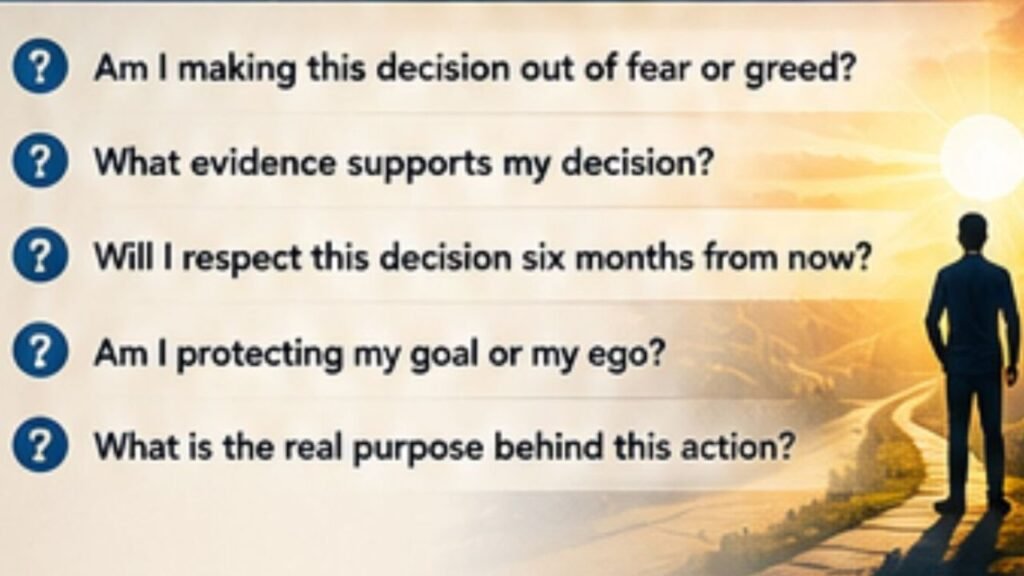
22. Five Questions to Ask Before Every Emotional Financial Decision
Whenever you feel an intense urge to buy or sell, ask:
Question 1
What emotion am I feeling right now?
Fear? Greed? Anger? Excitement? Jealousy?
Question 2
What evidence supports my decision?
Separate facts from assumptions.
Question 3
Would I make the same decision if nobody else knew about it?
This exposes social pressure.
Question 4
Am I protecting my financial goal—or protecting my ego?
This is a powerful question.
Question 5
Will I respect this decision six months from now?
Think beyond the emotional moment.
23. Build a “Panic Protocol” Before the Next Crisis
Do not wait for the next crash to decide how you will behave.
Create your personal panic protocol now.
Write down:
When markets fall sharply, I will:
1. Stop and breathe.
2. Avoid making an immediate decision.
3. Identify my emotional state.
4. Review why I invested.
5. Check whether my financial circumstances have changed.
6. Separate market noise from meaningful information.
7. Seek qualified financial advice when appropriate.
8. Make decisions according to my financial plan—not crowd behavior.
This is practical Gita wisdom.
Prepare the mind before the battlefield arrives.
24. The Investor's Daily Practice
Emotional control is not built during a crisis.
It is built every day.
You can develop financial mindfulness through a simple five-minute practice.
Every morning, ask:
What do I control today?
You control:
- Your decisions
- Your research
- Your spending
- Your saving
- Your risk management
- Your discipline
- Your reactions
You do not fully control:
- Markets
- Interest rates
- Political events
- Global crises
- Other investors
- Short-term prices
This distinction is liberating.
Focus your energy on what you can influence.
25. A Simple Gita-Based Investor Mindset
When markets rise:
Do not become arrogant.
When markets fall:
Do not become hopeless.
When others become greedy:
Remain thoughtful.
When others become fearful:
Remain analytical.
When you make money:
Remain humble.
When you lose money:
Remain teachable.
When the future is uncertain:
Remain disciplined.
This is emotional maturity.
26. Wealth Is More Than a Number
Suppose someone has a large portfolio but lives every day in fear.
They constantly check prices.
They cannot sleep.
They compare themselves with others.
They panic during every correction.
Can we really call that financial success?
The Gita encourages us to think about a deeper form of wealth.
What is the value of wealth if it destroys your peace?
Money should support life.
It should not become the master of your mind.
True financial wisdom seeks both:
External prosperity + Internal stability
That combination is far more powerful than wealth alone.
27. The Market Will Test You
Every investor eventually faces a difficult period.
It may be a market crash.
A recession.
A business failure.
A personal financial emergency.
A disappointing investment.
Or simply a long period when nothing seems to work.
These moments are not only financial tests.
They are tests of character.
They ask:
Can you remain calm when others panic?
Can you remain humble when others become greedy?
Can you admit a mistake?
Can you change your strategy without losing your identity?
Can you protect your peace while pursuing financial growth?
That is where financial wisdom begins.
28. The Final Lesson: Do Not Give the Market Control Over Your Mind
Markets will continue to fluctuate.
There will always be:
Good news.
Bad news.
Bull markets.
Bear markets.
Predictions.
Experts.
Fear.
Greed.
Excitement.
Panic.
You cannot control all of it.
But you can control one thing:
Your response.
That is the heart of the Gita’s wisdom.
The goal is not to predict every market movement.
The goal is to become the kind of person who can make wise decisions even when the future is uncertain.
Because the strongest investor is not necessarily the one who knows what will happen tomorrow.
It is the one who can remain clear-minded when nobody knows what will happen tomorrow.
A Final Message for Every Investor
The next time the market rises sharply, ask:
“Am I becoming greedy?”
The next time the market crashes, ask:
“Am I becoming fearful?”
The next time someone boasts about their returns, ask:
“Am I comparing my journey with theirs?”
The next time you feel an irresistible urge to buy, ask:
“Am I investing—or am I chasing?”
The next time you want to sell everything, ask:
“Am I making a decision—or am I escaping an emotion?”
And when uncertainty becomes overwhelming, remember:
You do not need to control the market to control your behavior.
That is where your real power lies.
The Gita’s wisdom is not about promising that you will never experience fear.
It teaches something far more valuable:
You can experience fear without becoming its servant.
You can experience greed without obeying it.
You can experience uncertainty without losing yourself.
You can experience a financial setback without losing your confidence.
And you can pursue wealth without sacrificing inner peace.
That is the real meaning of financial wisdom.
Control the mind.
Clarify the purpose.
Respect the risk.
Do your duty.
Accept uncertainty.
And never allow temporary market movements to decide your permanent peace.
.
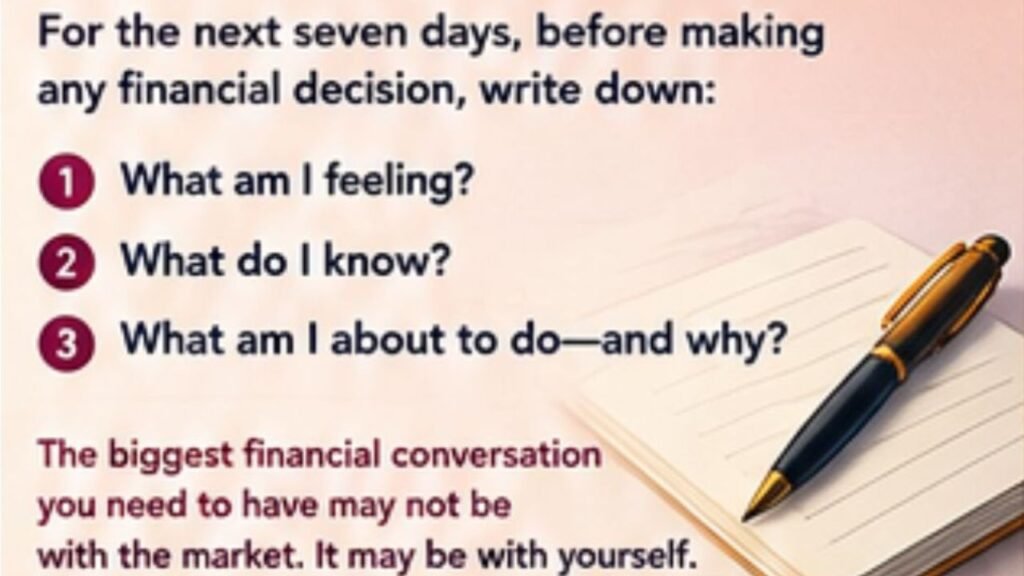
Your 7-Day Fear & Greed Challenge
For the next seven days, before making any financial decision, write down three things:
1. What am I feeling?
2. What do I know?
3. What am I about to do—and why?
Do not judge yourself.
Just observe.
By the end of seven days, you may discover something surprising:
The biggest financial conversation you need to have may not be with the market.
It may be with yourself.
And that conversation could change the way you invest for the rest of your life.

[…] Because fear hijacks clarity. […]