
Table of Contents
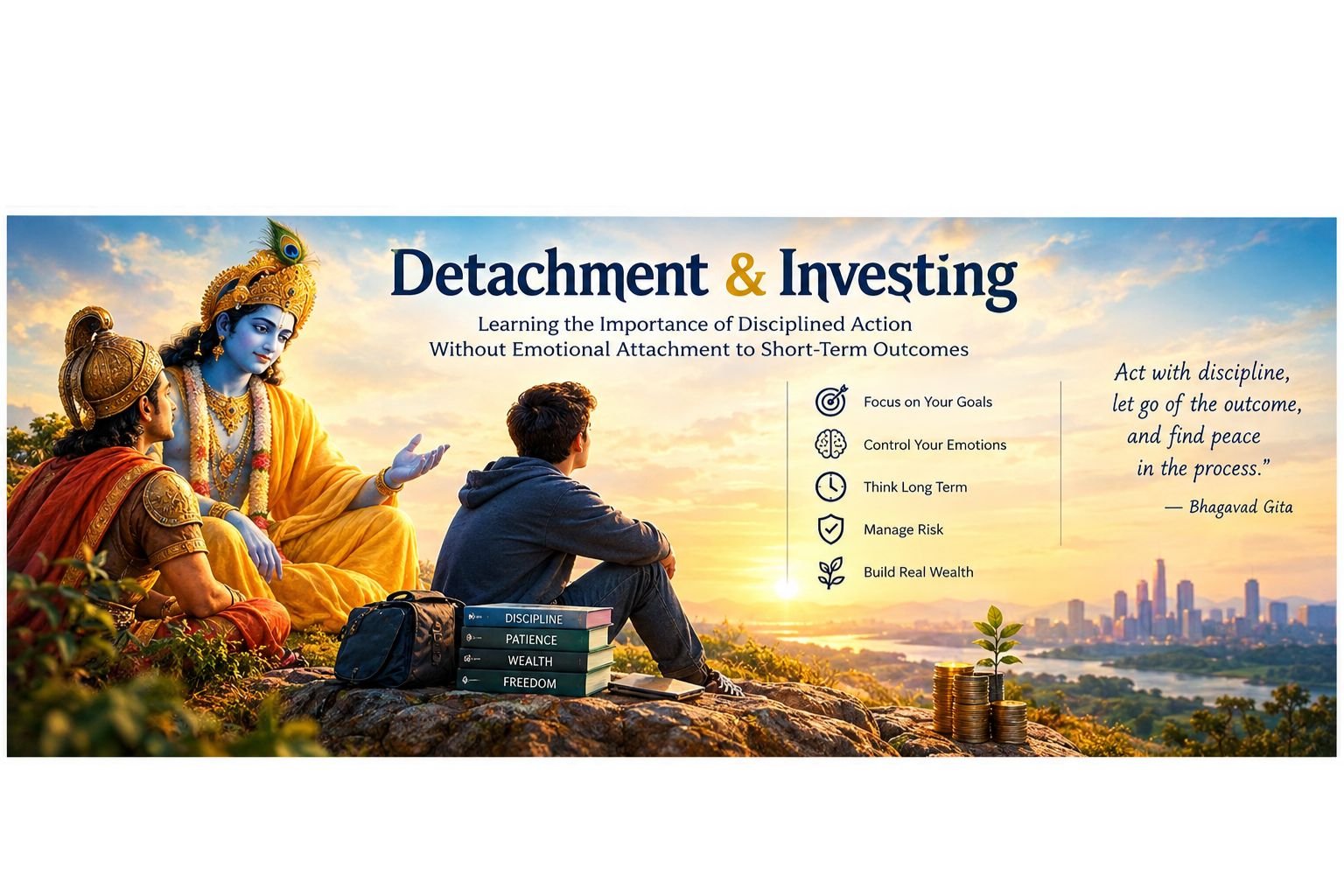
ToggleLearning the Importance of Disciplined Action Without Emotional Attachment to Short-Term Outcomes
Detachment from any thing Does Not Mean “I Don't Care for for anything”
When people hear the word detachment, they sometimes imagine someone who has no ambition.
They think:
“If I become detached, why should I try to make money?”
That is not what detachment means.
Detachment does not mean:
- Don’t have goals.
- Don’t work hard.
- Don’t care about your money.
- Don’t review your investments.
- Don’t learn from mistakes.
- Don’t improve your financial situation.
It means something much more practical:
Give your best to the decision you can control, while accepting that the outcome is not completely under your control.
This distinction is enormously important.
You can control your preparation.
You cannot completely control your examination result.
You can control your investment research.
You cannot completely control tomorrow’s market price.
You can control your spending.
You cannot control every economic event.
You can control your financial discipline.
You cannot control the entire future.
Detachment is the ability to remain committed to the process without becoming emotionally imprisoned by the outcome.
The Ancient Battlefield and the Modern Financial Market
The Bhagavad Gita begins at a moment of enormous uncertainty.
Arjuna stands on the battlefield of Kurukshetra.
He is overwhelmed.
He sees people he loves.
He is confused about what he should do.
His emotions interfere with his ability to see clearly.
Krishna does not tell Arjuna: “Don’t care.”
He does not tell him: “Ignore the consequences.”
Instead, Krishna guides him toward understanding his duty, responsibility, action and relationship with results.
This idea has extraordinary relevance today.
The battlefield has changed. Today, your battlefield may be:
- A stock-market crash
- A business decision
- A career choice
- An examination
- A relationship
- A financial goal
- A difficult professional decision
The external situation changes.
The human mind does not change very much.
Fear remains.
Desire remains.
Attachment remains.
Comparison remains.
And so does the need for wisdom.
The Gita's Famous Lesson About Action
One of the best-known teachings of the Gita is:
“You have a right to action, but not to the fruits of action.”
This teaching from the Gita is often misunderstood.
It does not mean:
“Results don’t matter.”
Results obviously matter.
If you invest money, returns matter.
If you study, marks matter.
If you start a business, profitability matters.
If you work, professional growth matters.
The deeper message is:
Your responsibility is to perform your action wisely. You cannot demand complete control over the result.
This is a profound distinction.
How Does This Apply to Investing?
Consider two investors.
Investor A
Researches an investment carefully.
Invests according to a long-term plan.
Accepts that prices will fluctuate.
Reviews the investment periodically.
Does not panic over every movement.
Investor B
Buys because everyone is talking about the investment.
Checks the price every hour.
Becomes excited when it rises.
Becomes terrified when it falls.
Changes decisions according to social-media opinions.
Sells during panic.
Buys again after prices rise.
Who is more detached?
Clearly, Investor A.
Not because Investor A doesn’t care about money.
But because Investor A cares more about making a good decision than about controlling every short-term price movement.
The Biggest Enemy of Long-Term Investing: Emotional Attachment
Suppose you buy an investment at ₹100.
A month later it becomes ₹120.
You feel intelligent.
You tell yourself: “I knew this would happen.”
Then it falls to ₹105.
You become nervous.
At ₹95, you become angry.
At ₹85, you panic.
At ₹75, you sell.
Three months later, it rises to ₹110.
What happened?
The investment moved:
₹100 → ₹120 → ₹105 → ₹95 → ₹85 → ₹75 → ₹110
But your emotions moved even more dramatically:
Confidence → excitement → anxiety → fear → panic → regret
The price fluctuated.
But your emotional state fluctuated with it.
This is emotional attachment.
Detachment Helps You Separate Price From Value
One of the most important questions an investor can ask during volatility is:
“Has the value of my investment changed—or has its market price changed?”
These are not always the same thing.
A market price can change because of:
- Investor sentiment
- News
- Interest-rate expectations
- Global events
- Economic uncertainty
- Market liquidity
- Fear
- Greed
Therefore, a falling price does not automatically mean that the original investment thesis has failed.
At the same time, detachment does not mean refusing to accept that an investment may actually have become worse.
This is crucial.
A detached investor is not blindly stubborn.
They are willing to say:
“I may have been wrong.”
That is wisdom.
Detachment Is Not Holding Forever
This is another common misunderstanding.
Some people interpret the Gita’s teaching as:
“If I am detached from results, I should never sell.”
Absolutely not.
An investment may need to be sold because:
- The underlying business has deteriorated.
- The original investment thesis is no longer valid.
- Your financial goals have changed.
- Your risk exposure has become inappropriate.
- You need liquidity.
- Your portfolio requires rebalancing.
Selling can be a disciplined decision.
Panic selling is different from disciplined selling.
The difference is the reason behind the action.
Panic says:
“I cannot tolerate this feeling anymore.”
Wisdom says:
“I have reviewed the facts, and this investment no longer fits my plan.”
That is detachment in action.
A Teenager Can Understand This Principle Too
You don’t have to be a stock-market investor to understand detachment.
Imagine you post something on social media.
You expect 500 likes.
You receive 50.
Immediately you think:
“Nobody likes me.”
But the number of likes is an outcome.
You controlled:
- What you created
- How thoughtfully you expressed yourself
- Whether it reflected your values
You did not control:
- Who saw it
- Who liked it
- When they saw it
- What they were doing that day
Now consider an examination.
You prepare honestly.
You give your best.
You receive a lower score than expected.
The result deserves reflection.
But does one result define your intelligence?
No.
You can learn.
Improve.
Change your strategy.
Try again.
This is detachment.
The result gives you information. It does not have to define your identity.
For Young Adults: Career and Money
A 20-year-old may apply for a dream job.
They prepare for weeks.
They attend the interview.
Then comes the email:
“We regret to inform you…”
Rejection hurts.
But attachment can turn one rejection into a story:
“I am not good enough.”
Detachment creates a different response:
“This opportunity didn’t work. What can I learn? What should I improve? Where should I try next?”
The first response creates helplessness.
The second creates growth.
The same principle applies to investing.
A loss is information.
A mistake is information.
A disappointing return is information.
Don’t turn financial information into a judgment about your worth.
For Adults: The Pressure to Build Wealth
Adults often carry responsibilities that teenagers don’t yet experience.
Education expenses.
Home loans.
Family responsibilities.
Retirement planning.
Healthcare costs.
Parents.
Children.
Business obligations.
Because money is connected to so many responsibilities, financial decisions can become emotionally intense.
This is exactly why detachment matters.
It doesn’t mean ignoring responsibilities.
It means avoiding decisions driven by uncontrolled fear.
Ask yourself:
“Am I making this financial decision because it is right for my financial plan—or because I am emotionally uncomfortable?”
That question can stop many impulsive decisions.
The Trap of Checking Your Portfolio Every Day
planting a tree. You water it today.Tomorrow you check its height.Nothing noticeable has happened.
You become worried.
The next day you check again.
Still nothing.
You begin thinking:
“Maybe this isn’t working.”
But growth takes time.
Long-term investing can be similar.
If your financial objective is measured in years, constantly judging your success based on daily price movements can create unnecessary emotional pressure.
Short-term information has value.
But short-term noise should not automatically dictate long-term decisions.
Detachment helps you maintain perspective.
What Social Media Has Done to Investing
Today’s investors face something previous generations did not experience at the same scale:
continuous financial comparison.
Open your phone.
Someone is celebrating a 200% return.
Someone claims to have found the next multibagger.
Someone says they made ₹1 lakh today.
Someone shows a luxury purchase.
Someone says: “If you haven’t invested in this, you’re missing out.”
Your mind starts asking:
“Why am I not making that kind of money?”
This creates greed.
And greed often leads to excessive risk.
Remember:
You are seeing someone else’s outcome—not their complete journey.
You don’t know:
- How much capital they invested.
- What risks they took.
- What losses they experienced.
- Whether the claim is accurate.
- Whether the result can be repeated.
- Whether the investment suits your circumstances.
Detachment allows you to admire someone else’s success without turning it into pressure on yourself.
Detachment Protects You From FOMO
FOMO—fear of missing out—is emotional attachment disguised as opportunity.
The market is rising.
You don’t want to miss it.
So you invest.
Then the market falls.
Now you regret the decision.
The problem wasn’t necessarily the investment.
The problem may have been the reason you entered it.
Before investing, ask:
“If nobody were talking about this investment, would I still consider it?”
If the answer is no, pause.
That pause is valuable.
Detachment and the Teenager's Fear of Failure
This principle should not be limited to money.
A teenager says: “What if I fail?”
Detachment responds:
“Prepare sincerely. Give your best. Learn from whatever happens.”
A young person says: “What if people don’t like me?”
Detachment responds: “Be respectful and authentic. You cannot control everyone’s opinion.”
A student says: “What if I don’t get the highest marks?”
Detachment responds: “Focus on learning and preparation. One result does not define your future.”
An investor says: “What if the market falls?”
Detachment responds: “Understand the risk. Follow your plan. Review the facts. Don’t allow fear to make the decision for you.”
Different problems. Same wisdom.
What About Greed?
Detachment is not only useful when markets fall.
It is equally important when markets rise.
Suppose your investment has already doubled.
You feel confident.
Then it doubles again.
Now you think:
“Why should I ever sell? It will keep going.”
Greed begins quietly.
The problem is not enjoying success.
The problem is allowing success to convince you that risk no longer exists.
Detachment asks:
“Has my financial situation changed? Has my risk exposure changed? Is my original plan still appropriate?”
Success should not eliminate discipline.
What About Fear?
Fear works in the opposite direction.
Your investment falls.
You think:
“I need to get out immediately.”
Detachment asks:
“What exactly has changed?”
Not:
“What am I feeling?”
But:
“What do I know?”
That shift—from emotional reaction to thoughtful observation—is one of the most powerful habits an investor can develop.
The Three Questions of a Detached Investor
Before making an emotionally charged financial decision, ask:
1. What can I control?
My research.
My savings.
My asset allocation.
My risk management.
My behavior.
2. What cannot I control?
Tomorrow’s market price.
Economic shocks.
Global events.
Other investors.
Interest-rate surprises.
3. What is my responsibility?
To make the best decision I reasonably can with the information available.
This is where the Gita’s teaching becomes practical.
Control your action.
Accept uncertainty.
Do not surrender your peace to the outcome.
A Simple “Detachment Test” for Investors
Before buying or selling, ask yourself:
Am I acting from:
Fear?
“I want to escape.”
Greed?
“I want more before it’s too late.”
Ego?
“I must prove I was right.”
Comparison?
“Everyone else is making more money.”
Patience?
“I understand my plan and remain disciplined.”
Wisdom?
“I have reviewed the facts and am acting consciously.”
Your answer can reveal more about your decision than another market prediction.
The 24-Hour Rule
For emotionally charged financial decisions, consider creating a personal rule:
“If I feel extreme fear or excitement, I will pause before making a major decision.”
Give yourself time.
Step away from the screen.
Write down why you want to act.
Review the original investment thesis.
Consider the downside.
Then decide.
You are not avoiding action.
You are creating space between emotion and action.
And that space can be the difference between an impulse and a decision.
The Gita's Wisdom for Every Age
The beauty of this teaching is that it does not belong only to investors.
For a teenager:
Study sincerely, but don’t make marks your identity.
For a college student:
Build your skills, but don’t measure your worth against someone else’s success.
For a young professional:
Work hard, but don’t let promotion determine your self-worth.
For an investor:
Invest intelligently, but don’t let daily prices control your emotions.
For a parent:
Guide your children, but understand that you cannot control every choice they make.
For an entrepreneur:
Build your business with discipline, but accept that every outcome cannot be predicted.
For everyone:
Give your best to what is in your hands. Accept what is not.
Detachment Does Not Reduce Ambition
This is perhaps the most important message.
You can be ambitious and detached.
You can want wealth and remain detached.
You can want success and remain detached.
You can want excellent marks and remain detached.
You can want a promotion and remain detached.
You can want your business to succeed and remain detached.
The difference is this:
Attachment says:
“I must get this result, otherwise I cannot be happy.”
Detachment says:
“I deeply want this result, so I will work sincerely for it—but I will not allow the result to destroy my inner balance.”
That is a much stronger position.
The Modern Meaning of Karma Yoga
The Gita’s concept of Karma Yoga can be understood in a very practical modern way:
Do your work with excellence, sincerity and discipline, without becoming enslaved by the reward.
For an investor, this means:
Research properly.
Understand risk.
Set appropriate goals.
Invest according to your plan.
Review your assumptions.
Learn from mistakes.
Remain disciplined.
And then accept that the market will do what the market does.
For a student:
Study.
Practice.
Prepare.
Take the exam.
Learn from the result.
For a professional:
Work.
Develop skills.
Take responsibility.
Seek excellence.
But don’t allow one appraisal, promotion or rejection to define your identity.
The Most Powerful Investment May Be in Your Own Mind
We often talk about investing money.
But there is another investment that can transform every area of life:
Investing in emotional discipline.
Because a person with financial knowledge but poor emotional control can still make destructive decisions.
A person with moderate financial knowledge and strong discipline can often avoid many unnecessary mistakes.
The goal is not to become emotionless.
The goal is to become aware of your emotions without allowing them to control your decisions.
That is emotional intelligence.
A Practical Detachment Practice
The next time you feel emotionally disturbed by an investment, take five minutes.
Write:
WHAT HAPPENED?
State the facts.
WHAT AM I FEELING?
Fear? Greed? Anger? Excitement? Regret?
WHAT AM I ASSUMING?
Separate facts from predictions.
WHAT CAN I CONTROL?
Identify your actual choices.
WHAT DOES MY PLAN SAY?
Return to your financial objective.
WHAT IS THE WISEST ACTION?
Only then decide whether action is necessary.
This simple exercise turns an emotional moment into an opportunity for conscious decision-making.
The Final Lesson
Markets will rise.
Markets will fall.
Your investments will sometimes perform well.
Sometimes they won’t.
You will make good decisions.
Sometimes you will make mistakes.
Life will do the same.
The question is not:
“How can I make sure everything goes according to my plan?”
Because nobody can.
The deeper question is:
“How can I remain wise when life does not go according to my plan?”
That is where the wisdom of the Bhagavad Gita becomes relevant.
Detachment does not ask you to stop caring.
It asks you to stop clinging.
It does not ask you to stop pursuing success.
It asks you not to become a prisoner of success.
It does not ask you to ignore results.
It asks you not to let results completely control your mind.
And it does not ask you to stop building wealth.
It asks you to build wealth without losing your inner wealth.
Remember This Before Your Next Investment Decision
Research before you invest.
Understand before you follow.
Plan before you react.
Pause before you panic.
Review before you regret.
Learn before you repeat.
And most importantly:
Control the quality of your action.
Don’t surrender your peace to the uncertainty of the outcome.
That is not only an investing lesson.
It is a life lesson.
And perhaps that is why an ancient conversation on a battlefield still speaks so powerfully to a teenager holding an examination result, a young professional facing career uncertainty, a parent planning a family’s future, and an investor watching the market fall.
The battlefield changes.
The human mind does not.
And the wisdom to master that mind remains timeless.